by Regan Chern
She only wore those Coca Cola jeans to piss off her father. An old family friend told me. It’s the best portrait I have of my mother. No photos. Just the vision of a wise-cracking girl who’d disappear to the rodeo in a stranger’s car, who’d run hot showers for so long that atop the stovepipe there’d be a smoke trail a kilometre long. She’d fight her parents—large inconsolable, screaming matches—until she’d hitchhike to the old family friend’s place in Weipa. He’d drive her back down. She couldn’t stay.
Her childhood is a memory, walled off by time.
Time. Ever-increasing. Ever-distorting.
When my older sister was born, my mum got herself a nice camera. A Canon EOS 5D. And several expensive lenses. She took it on holidays, to parks, to museums, and aquariums—always capturing our little, fixated faces. Constant preservation.
New Zealand, Easter holidays 2018. The first time we saw snow. She posed us playing—‘build a snowman’, ‘throw a snowball’, ‘look like you’re having fun’—in the same place the Chinese immigrants starved to death in the 1860s while searching for gold. The shutter winked at us with a smile. Click-click.
Mum pushed Dad out onto a pier at one of the lakes. Eddies of white ice came after them. He posed, shivering and breathing hard. With her camera in tow, she’d dance around him. Each of her movements were punctuated by the shutter click as it enclosed the scene. Snow-topped mountains. The grey-white watercolour of the sky. A moment held, then lost.
This less grey, less wrinkled, less freckled iteration of my father was printed into one of Mum’s photography books—his warm face against white. There are versions of ourselves between these leaflets. One of my siblings and I as babes in large, soapy buckets with rainbow spiral lollipops and grinning Red 40 dyed lips. Then on hardwood floors, crawling away, my arse staring boldly into the camera.
My mum doesn’t exist in these pages. No photo bears that wise-cracking girl.
Her presence exists only in the framing.
On a trip to the science museum, Mum snapped a pic of her three children against the ‘Lunar Module Eagle and Earthrise’ photo. The image was taken during the Apollo 11 mission by Michael Collins. It depicts the Module just off the Moon’s surface and in the distance, a crescent Earth emerges. They say the photo contains every person dead, alive, and not yet living, except the man who had captured the image himself.
And yet, Earth, so far and small, appears abandoned against the black sea. The module enclosing Buzz Aldrin and Neil Armstrong is so full of its own perfect machinery that one would question whether it contained any life at all. Only Collins’ eye is seen—his camera lens clips the viewport in a shadowed blur. Some token of life’s imperfection. Collins’ personhood felt intimately.
This photo was taken in July of ’69. My mum was born a month after this moment in Cape York, where the knife-tip of Australia strikes the Arafura Sea. She lived on a cattle farm where the smell of manure, of fresh grass, of heirloom furniture all contrasted the shiny austerity of that spacecraft splitting the sky, stratospheres above.
I flip to the next page. We’re all smiling, all poised, all carefully set.
Here, I thought about truth. Then, I thought about my mother’s absence from the frame, again.
If her face were pictured, would it convey too much truth: too much of her childhood abuse, of summers that only burnt her, of the anger and resentment for the life she lost when she had us?
Did she wield her lens not just to capture us in the flux of time, but to rewrite the way we remembered each other?
I could never answer these things. How could I bring myself to ask?
Rather, these images will sit beside these questions—in archival boxes, in hard drives, and CD’s left to grow stale. By my mother’s design, these curated images will be the memory my family will become.
My younger sister has inherited this same curatorial instinct (as well as my mother’s unyielding spirit). But where my mother looked outward with her lens, my sister turned it on herself.
Selfies exchanged on Snapchat are scored.
Many hours FaceTiming friends, sometimes even sleeping with the camera pointed at her face.
Instagram is her diary, the pages held out to a public audience.
Her life is lived in the precise framing of that lens: lips glossed, eyelashes curled, endless white smiles whether genuine or not. Shopping hauls of new dresses and makeup and perfume documented for her friends. Road trips are filmed and watched entirely through her iPhone. Rare family dinners interrupted by questions over which witticisms or images should be posted, and in what order.
Her experiences aren’t so much lived as they are recorded, remembered for her in 1179 by 2556 pixels, depicted on a 6.3-inch OLED display.
Her actions, I feel, aren’t born of vanity.
They are distraction. Escape. Approval.
Even her hardest days—full of loss and loneliness and anger—are filtered through a rosy lens. By reframing the image, pain becomes nostalgia. And with memories displaced, she can believe in that softened truth. History is forced to a new path, its lessons lost.
This purge of hard truths isn’t unique to my sister or her generation. History is full of people who’ve altered our collective memory.
In the 1930s, Joseph Stalin presented photos of himself beside Vladimir Lenin. In warm black-and-white, they walk side-by-side along a river, faring the Siberian frost in wool coats. They appear intimate—friends, confidants, perhaps even lovers, coy smiles traded on a park bench.
In truth, Stalin had photoshopped Lenin into these photographs—a daring attempt at legitimising himself as the Leader of the Soviet Union following Lenin’s death. A man who had once requested Stalin’s removal from his party, deeming him ‘rude’, ‘intolerant’, ‘disloyal’, and ‘capricious’.
By airbrushing Lenin into his company, Stalin purged his country—quite thoroughly—of the doubt to his throne. Scars from smallpox, age, and war were also erased until he was silky smooth all over. An impermeable newborn. A god rendered in sepia.
I imagine him, much like my sister, hunched at a desk, swooning over these images, reminiscing a life he did not lead. He’s trying to convince himself of his power—Yes, I was good friends with Lenin. More than friends. Lovers in dreams. Married to each other through ideas. And now I must take on the great burden of my inheritance. Oh, my lost love, he’d say, staring into the ever-watchful eyes of a mass-manufactured Lenin bust.
In 1956, the deceased Stalin was denounced by his successor in The Secret Speech. Here holds the revelation that Stalin’s immense stature was built atop self-mythologies, doctored photos, and a mountain of spent bullet casings—each one used to morph illusions into truth. His indulgent legacy crashed down into Earth and disappeared into those murky depths.
I worry that my sister will go through a similar crash. Because who is she without her warped camera? And does she know?
She tries to convince the world that she’s worthy of her life, but more so, to convince herself. By reshaping and smoothing and dieting and exercising and by having the right friends and the right material possessions, she can look like the right sort of person. A deserved person. Constant rebirth. Constant uncertainty. Do they want me? Do I want me? How can I be wanted? But where does it end? It never ends.
For now, she’ll sleep, eat, breathe with her camera ever-watching her: a glassy eyed toy, wanting to be loved again and again. It is so lonely.
But she’ll remember it a different way. Some image can convince her otherwise.
By comparison, my older sister’s camera does—did—seem to stand against my mother and younger sister’s lenses. Her photos cringed with truth. The awkward whims of adolescence. A shaky frame shot on a grainy iPad camera. Saved images of melodramatic 2016 Tumblr poems fill in the spaces between mundane images of a gecko, of views from car windows, of long-lost toys, and corded headphones.
She anchors herself in her imperfect reality. Acceptance in place of escape.
She’d often perform skits. Context and a greeting are offered to the camera, friends or siblings interject with laughter or a juvenile comment, then the action commences.
In this one, she’s showing you how ‘normal people’ fall asleep, and then how she does. The camera constantly dips away from her performance—give thanks to her giggling 5-year-old sister videographer.
In the background: an argument in the kitchen. A glass shatters. Voices compete for dominance.
She stares defiantly into that lens, then turns to shake her butt because somehow this is related to how she falls asleep. My younger sister’s laugh drowns out the distant noise.
The show must go on.
Here, the lens is secondary to their personal entertainment. The camera’s only purpose: raw preservation. Her archives don’t try to hide pain or imperfection. They show her self-discovery.
Images of good friends who’d turned bad.
Pictures of an infected wound, a shrunken sweater, a burnt cake.
The hard lessons remembered alongside the good.
I believe Eve Arnold caught this in her photographs of Marilyn Monroe—this struggle for growth.
Arnold shot her against Nevada’s plains and mountains. She was the only female photographer to capture the icon so extensively. Marilyn was filming for The Misfits whilst Norma Jean was trying to leave the Monroe persona behind; she wanted to be taken seriously as an actor and not just a sex symbol.
Arnold captured her breathing into her hand, her blonde curls bound, her fingers held to her quiet lips. Dry wind casts itself across the flat desert. A boom mic shoulders the left of the image, listening in. The camera is held steady on her, watching. Her body is clenched, like Rodin’s The Thinker.
I imagine Norma asking herself of what’s next. What’s next?
She bares denim armour, a Western hero. Hollywood glamour feels like a forlorn dream—no white cocktail dresses, no beauty-marked smiles, no tight curves aside from the black-and-white mountains. Nothing cushions her.
Lonely Monroe on another set, another stage.
The Misfits was the last movie Marilyn completed before she died. It was the last for all the leads before their untimely deaths: Clark Gable, Clift Montgomery, Marilyn. Curses of the Indigenous burial ground they filmed upon, some say.
In The Misfits, Marilyn’s arse is slapped over and over. She runs in a strapless bikini into a man’s arms. In 2018, they recovered Marilyn’s deleted nude scene in the film, feeding the public’s insatiable hunger for this dead woman.
Critics would later say it was one of her best performances. That she’d managed to pull off a serious dramatic role. This was achieved somewhere between the incessant arse-slapping.
The film was made during her third and final marriage—her last hope—to the Pulitzer-winning playwright who wrote The Misfits. Their relationship fell apart on that production. He realised he couldn’t save ‘the saddest girl’ he had ever met.
To me, that is what Arnold caught. The same raw preservation as my sister: the cringy, devastating, necessary truth of dreams and downfalls. The show going on.
Always asking: What’s next?
It’s a hard way to live, admittedly, but it’s honest and driven. In my sister’s lens, everything good and bad is remembered for next time. To be replayed. Over and over.
That used to be her.
As her own self-preservation took precedence to the preservation of unfiltered memory, her lens became more of my mother’s and younger sister’s. Curated happiness, mass marketed. Sharp edges softened. Awkwardness concealed.
I scroll to the next slide. It’s a video.
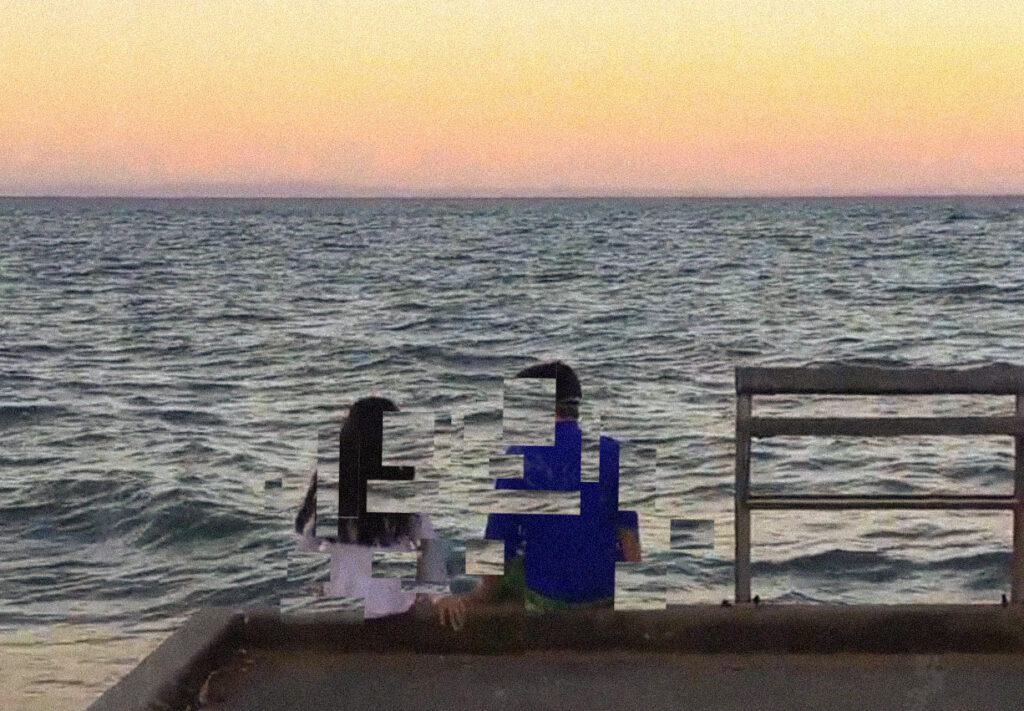
My older sister holds the camera. My younger sister and I are seen on the furthest edge of a jetty, somewhere on the Redcliffe Peninsula. It reminds me of the pier in New Zealand—of Mum photographing Dad against a similar grey-white watercolour sky.
Jump in, my sister calls to us. I whisper something of comfort to the little girl beside me. She clasps my hand. I squeeze back.
We sit down on the ledge, too nervous to brave the distance between here and the murk below. We slip out of the frame in a gasp.
I snap the mental image of us there, then gone. It is the best portrait of my family I have.
There, then gone.
Author Bio
Regan is in his final year of a BFA (Creative Writing) at QUT etc.… do you really need to know more than that? You could be reading my work instead, you know. It’s far better than any dry self-aggrandising drivel that I could’ve written for this bio.
If you’d like to contact me, do so through my Instagram: @regancchern