By Catherine Maticka
1
You may feel like an avatar in a video game.
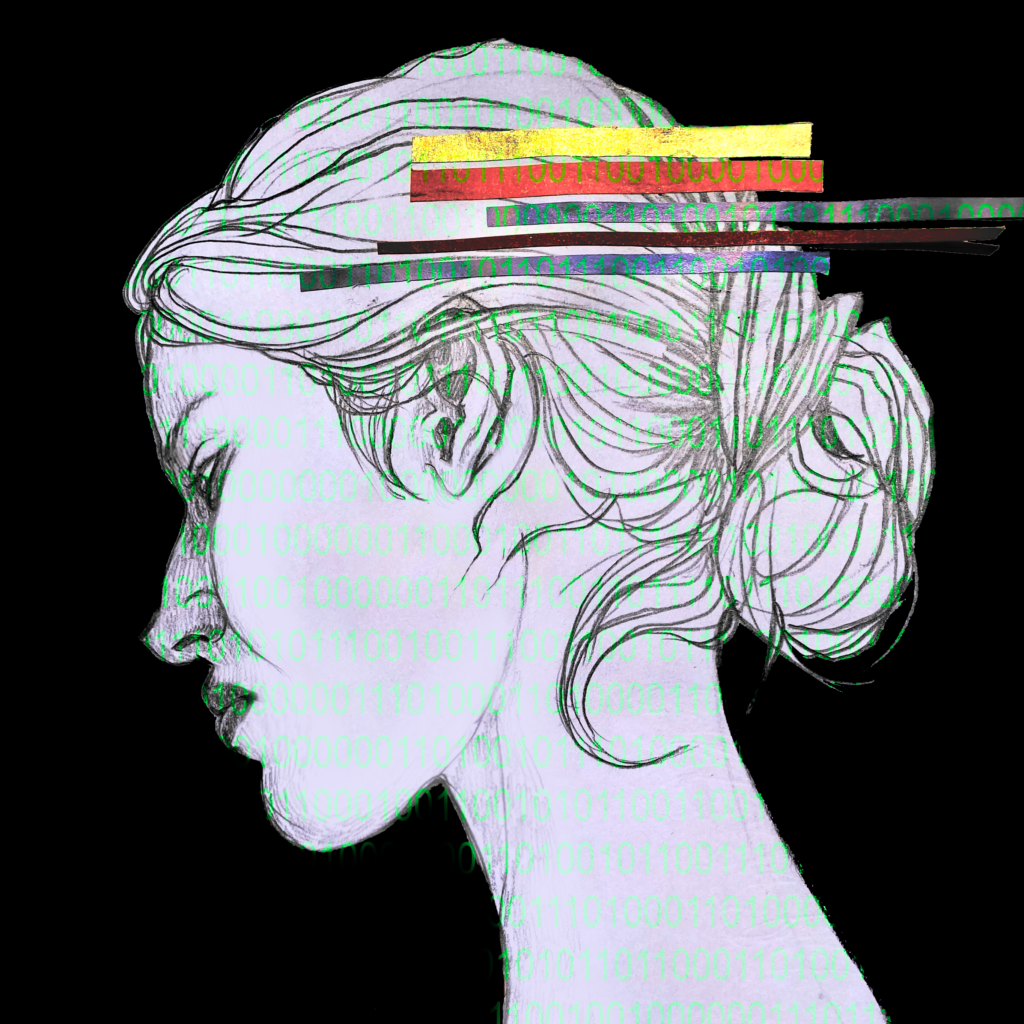
You may feel thin as a hologram, your body as intangible as the ones and zeros in a line of code. This is expected.
Your body is not yours. Not the way it was before. Fighting this feeling may worsen your situation.
Yet, the sight of old family friends may transport you back to the warmth of your girlhood.
The face of a woman who took you under her wing many years ago could be enough to bring you to tears.
Always subdue these irrational outbursts of emotion. Our Citizen Agents cannot risk losing their composure.
2
The constant hum of traffic along the Manhattan cobblestone streets proves effective in drowning out unwanted voices.
Guilt might feel all-consuming, as you, incapacitated, watch someone else buckle your 8-month-old child into the backseat of a car.
A mother wants nothing more than to hold her child in her own two arms.
Remind yourself that your honourable government service has contributed to a dazzling, collective tapestry of human sacrifice.
Your martyred body is just a small cog in the machine of the new heroism.
3
When in public, obscuring your face with a black hood and oversized sunglasses may alleviate the feeling that you are being surveyed.
If, perchance, government surveillance bugs are nested inside your brain, the enemy may be surveying you from the inside out.
In this case, the black-hood-and-oversized sunglasses combo is useless.
The body itself will need a thorough cleaning.
4
An unassuming bar near Penn Station is an effective front for a discrete operation.
Like falling down a trap door, a rabbit hole, or a portal, the entrance to the clinic might remind you of something from a Dungeons & Dragons game.
Glowing purple light can hypnotise the senses of the young and old alike.
Watching your child slowly fall asleep amid the neon glow might also send you into a state of entrancement.
As the ring moves from your feet to your shins, thighs, hips, and collarbones, it may feel appropriate to whisper a prayer.
Pray that the machinery finds some item of physical proof, some evidence that you have not gone insane.
Pray that the destruction of the extracted weevil, and the smashing of its synthetic
scales, will be the resolution that saves you.
When the cleaner tells you he’s found nothing, you will feel hot tears spill from your eyes and into your mouth.
You may doubt the clinic’s legitimacy. But eventually you will identify your own brain as the true source of error.
The weevil will always feel embedded in your brain.
The bullet will always feel lodged in your arm.
You will, at times, taste the tang of the sea salt, feel the daggered rocks stabbing against your cheek, or hear the pulse of the speedboat tearing through the waves.
Know that these are just mirages.
Distant as the fantasy landscapes of a children’s story book.
They are the ghosts that linger in the aftermath.
Exegesis
This response to Jennifer Egan’s dystopian novel, The Candy House, focalises a scene from ‘See Below’ through Lulu’s perspective (251-302). Second person voice allows the reader to directly experience her traumatised state after serving as a government spy. I aim to closely examine Lulu’s fear of government surveillance post-mission, during which ‘weevils’ (surveillance bugs) were embedded into her brain.
In See Below, Lulu’s husband mentions that she still thinks ‘aphoristically in the second person’ and is paranoid about government spyware (251). To explore this, I adopt an instruction manual format, using terse phrases to convey the technological stratification of Lulu’s thoughts post-mission. This device is crucial in characterizing Lulu and exploring her traumatised state.
This piece also enables a closer examination of the novel’s key themes, especially the encroachment of technology in daily life and on human bodies. Technological determinism is also explored through the strict filtration of Lulu’s thoughts through the format of government machinery. The consequences of transhumanism are investigated through Lulu’s intense feelings of disembodiment after the weaponisation of her body as a technological instrument during her mission.
Works Cited
Egan, Jennifer. The Candy House. United States, Scribner, 2022.
Author Bio
Hi! I’m Catherine (she/her), a Brisbane based visual artist in my third year at QUT. Often exploring feminist, political and technological contexts in my work, I aim to interrogate what it means to be human, in the face of AI and algorithmic culture. I’m looking forward to putting on my rose coloured glasses and reminiscing on the past for our upcoming issue, Timestamp!