By Sailor Rose
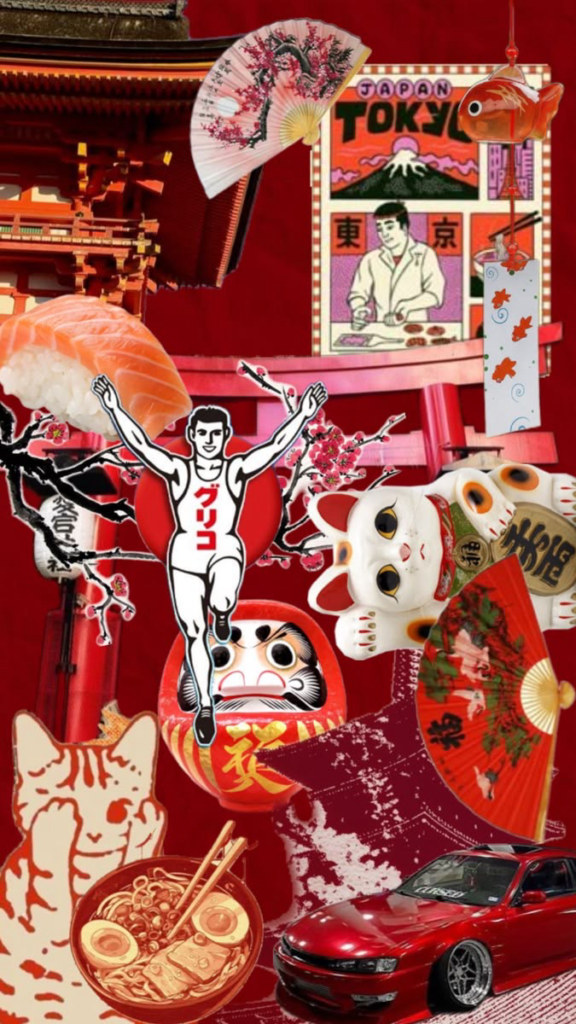
One of the first issues that I came across during my recent trip to Japan was my clothing. Was it that I had packed for the wrong weather, packed too little or packed for the wrong type of activities? No. I had packed two pairs of dark brown pants that looked quite similar when photographed. Twenty years ago, this would not have been a problem for anyone. However, contemporary travellers are more aware than ever of their appearances because of the way that we now find ourselves documenting our lives. This formerly mild and increasingly more extreme obsession with personal aesthetics and the editorial quality of the places that we were visiting became starkly apparent to my mother and me during our recent two-week expedition of Japan’s better-known tourist locations.
Our journey began beneath the dizzyingly bright neon billboards of Tokyo’s bustling Shinjuku District. Arriving in a foreign country after dark is usually accompanied by both scepticism and extreme caution. Even though we found ourselves noisily wheeling our oversized suitcases down would-be-sketchy alleyways advertising women in an array of costumes obviously designed for after-hours entertainment, we never felt unsafe like we would have in a similar street in Australia. The walk to the hotel only took us twenty minutes and would have been faster had we not let our feet distractedly wander as we took in our new surroundings instead of abiding by the route meticulously mapped for us by Google. Despite this short interaction with Tokyo, we still found ourselves posting the first photos of our trip that same night.
The fact that my mother and I both have secondary Instagram accounts dedicated to the documentation of our travels speaks volumes about the ways that modern travellers share their experiences with friends and family. Part of our daily routine while travelling included time in the evening dedicated to sorting through pictures, selecting the shots that we thought most worthy of attention and then curating picture carousels to be posted to our followers. Our dedication would suggest a substantial following and that suggestion is misleading indeed. Regardless, I’ve come to treat my various Instagram accounts as photo albums of sorts – easily accessible digital copies of my life that are always available to show to new acquaintances. It’s very convenient but I know it lacks the authenticity that the dozens of mismatched photo albums stored in boxes in my mum’s garage would hold.
During the second week of our trip, I was reclined on my mattress in our Ryokan, reliving our day photographically. I wore a traditional blue and white robe which was belted firmly around my waist and grey socks that had toe sectioning reminiscent of a ninja turtle. I was fresh and warm from my visit to our accommodation’s private Onsen. And I was refusing to add images to my post that aesthetically clashed with the others. The indoor kimono photos simply could not occupy the same post as the outdoor deer selfies – such an act would be criminal. I would rather subject my followers to three separate posts in a single day than have incompatible photos in the same post.
On our last day in Kyoto, we finally took the time to hire a Jinrikisha. Jinrikishas are small two-seater carriages which are pulled by the strength of a single man. We helped ourselves up to our seats using a small wooden stool and slotted our backpacks safely behind our calves before a red blanket was draped over our legs. Our guide pulled the sunshade over our heads before he effortlessly lifted us up and set off at a light jog through the crowded streets of Kyoto. We felt like royalty. One of the first things that was pointed out to us during the guided part of our tour was the Kimono Forest and, when Mum and I showed no recognition at the mention of its name, our guide clarified ‘popular for Instagram photos’. Later on in the tour, our guide pointed out a particularly busy coffee shop that we had noticed during our exploring earlier in the day – it too was given the tag ‘popular on Instagram’. It seemed that the tourism industry was also very aware of the modern desire to hit the internet-famous photo locations. Regardless, the ride continued and there was much more to see than a few kimono-wrapped poles that were much more faded with sunlight than any filtered Instagram photo would show with the saturation pumped to the max.
The main destination of our Jinrikisha ride, by no coincidence, was the well-known Arashiyama Bamboo Forest. It felt so organic to be beneath the tremendously tall stalks of bamboo, the soft sounds of our guide’s feet padding against the soil, his quiet breath to match. It was ethereal. The reverie was broken when he stopped in the middle of the lane, repositioned the Jinrikisha and requested one of our phones since we were about to partake in a photoshoot. Mum surrendered hers since mine had ironically run out of storage – too many photos, of course. I should have been outraged at the interruption but I was relieved. Even amongst the blue-green tinted light of the bamboo, I had been considering if there was a way to get a better photo of us riding in the Jinrikisha and now, I wouldn’t have to worry. Our Japanese guide directed our poses and photographed us with the familiarity of someone who spent their days repeating a monotonous task. I watched him fiddle with the sliders as he edited the image to make it more vibrant. He told us, with a smile, that his company trained their employees in photography. This small man with his concrete thighs, who was telling us to try sashimi while pulling us in a vehicle that was invented one hundred and fifty years ago was pointedly documenting our experience. And I was grateful.
We absolutely loved our time in Japan but it would not be an international holiday, or a holiday at all, without the bad days too. And what constituted a bad day for us in Japan? Well, simply put, it was a bad photo day. During these unavoidable moments of self-loathing, when everything felt and looked wrong and the world seemed unfixable, Mum often mused about a camera-free world where we wouldn’t have to worry about appearances and could simply enjoy the moment. Unfortunately, more often than not, our awareness had little to no influence on our determination to fill our camera rolls with pictures proclaiming an exceptional day, every day. Occasionally, we would relent and find moments of reprieve but it was curious to see how reluctant other people around us were to relinquish their constant thirst for content creation.
In a way, we are fortunate that many tourist destinations limit or completely ban any form of photography. It forces us to appreciate the places that we have journeyed to visit and participate in the moments that we possibly did not expect to find. But, for many, local law and the risk of a fine is not enough to deter them. This was particularly apparent during an afternoon that we spent wandering around Kyoto’s infamous geisha district, Gion. Despite the still-glossy ‘photography prohibited’ signs that had been strategically positioned throughout the main streets, the other tourists seemed utterly unashamed to take photos of anything and everything. The worst of this occurred when a rare sighting of a genuine geisha was met with the clicking of cameras pointed both directly and discreetly at their target.
And the tourists weren’t just unconsciously tainting their own experiences, they were also contaminating the lives of locals. Early in our trip, during our first cultural expedition to Senso-ji Temple in Asakusa, I found the clammer of the tourists to be distracting to the point of comicality. Upon approaching the temple, we walked through some second-hand ritualistic smoke, up the steps and into the temple. Some form of religious proceeding was unfolding behind a sheet of protective mesh that kept the tourists from swarming the area. In the crowd, some people prayed in agreeance and others pointed their phone cameras at the ‘no cameras’ signs. The words of the ceremony were interrupted by the clanging sounds of tourists shaking wooden sticks inside of metal cylinders in the hopes of provoking a good fortune. Obviously, I was unimpressed yet I have my own fortune plastered to my travel journal, pridefully taking up an entire page.
Ironically, it was the things that we didn’t capture on a camera that were the best pieces of our trip. It was the quirky street fashion of Tokyo City. It was storing our suitcases beneath the bed because our room was impossibly tiny. It was using the bidet for the first time and not knowing where the water would strike. It was, most definitely, the cold 7-Eleven noodle salad that we got four times in our two weeks – the best food we ate yet not worthy of a photograph in its ugly plastic packaging. It was exploring our first gacha arcade and searching through our purses for silver one-hundred yen coins. It was the delicate crunchy shell that encased the sweet strawberries of the Tanghulu that we purchased on a walk home one evening. It was the moments when the cherry blossoms blew from their branches to swirl around us and cross our path – this we tried to capture but the blossoms kept themselves small and hidden from our efforts. It was seeing our first ‘Beware of Bears’ sign. It was the kendo fighting that we accidentally stumbled across during our exploration of Osaka Castle and the guttural screams of the fighters that led us there. It was the oddly shaped turtle that we spotted at a pond near the Tokyo Imperial Palace, so unlike the ones that we have encountered in our creeks back home. It was carefully selecting sheets of patterned Kami to fold origami deer at Nara. It was sitting in a tea house, shoes off, garden blooming, koi swimming, poetry writing and eating spoonfuls of matcha ice cream. It was the gallery of ceramic, colour-shifting dragons that were much too expensive to buy and yet cheap enough to look at. It was sampling the terrible street food at Maruyama Park, not being able to find a bin afterward and shamefully abandoning the remainders in a train station toilet cubical. It was watching the geishas in their traditional outfits performing for their silent crowd at Miyoko Odori. It was the houseboat cruise that we spontaneously took across the Katsurgawa River and the food boat that pulled up by its side to offer us their wares. It was the frantic exchange of goods for cash and the sizzle of squid being cooked in front of us. It was laughing with my mum at jokes we can’t remember.
It was every little thing that a photo could never capture.
Author Bio
Hi, I’m Sailor! But to know me a bit better I’m Rory Gilmore, Hermione Granger, Susan Pevensie and Belle. I adore reading fantasy and queer romance novels and I love to write them too. If I’m not reading or writing, you’ll find me doing some copywriting for my super-cool jewellery job, interning at a local publishing house or working on the latest issue of ScratchThat. As long as I have a cup of tea and some Ludovico Einaudi, I’m ready to write!