Written by Carmen Coertzen
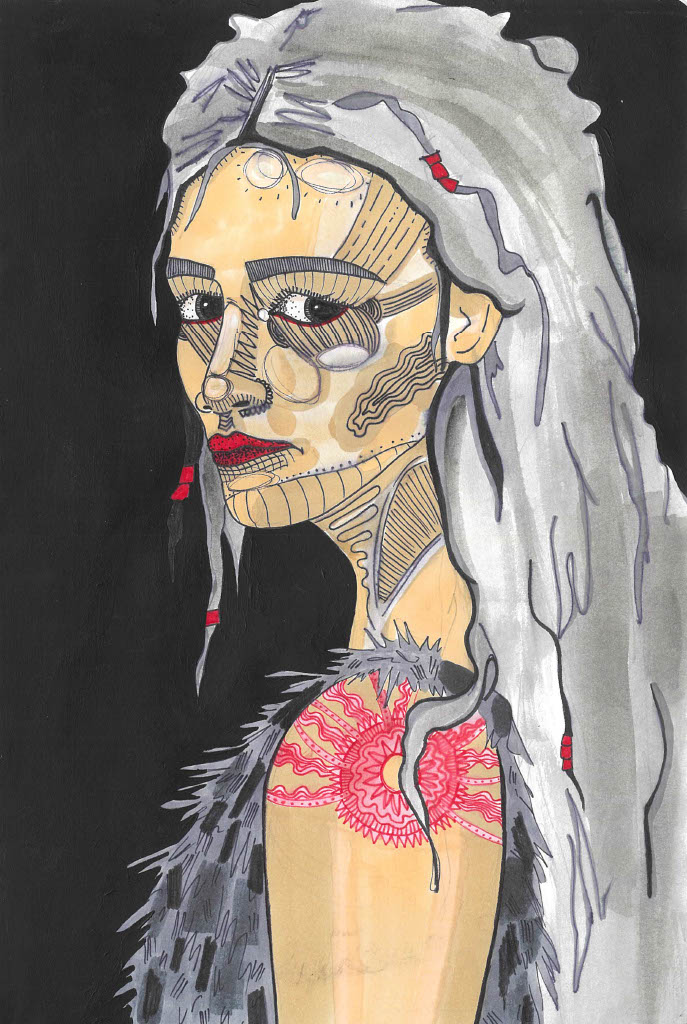
I carry the wicker basket of dirty laundry. It is yet early, and the breeze of morning is rustling through the trees, taking their leaves across the amber-cast sky. Little creatures scamper here and there, through the woodland underworld of mulch, and ferns, and pine needles. I weave through the path and come out by the river.
The water is ice to my fingers, stinging me softly like the snow’s kiss in the winter or a nettle’s touch in the summer. It runs over my hands that work and wring the fabrics over. My low hum falls down and splashes in the water. The fabric in my hands becomes white again, the dirt carried down by the stream. And there goes my voice right beside it. Carried away by the water.
Where does this river go? I think. Perhaps to a distant sea. Perhaps all over the world.
The world of which I know nothing. The world which I cannot see, for my view is obscured by this forest, and these clothes, and the mist of the rapids downstream.
I hear a faint humming join mine, and I fall silent, and turn my eyes to the distant shore of the opposite riverbank. It is only metres away. It is many miles. She is there again, the woman. She is dressed only in black wolf skins. White shoulders stained red. Her blonde hair is long, and knotted, and never been cut. She is barefoot and pale and shining. I see all the wilderness within her and I am afraid. But I am not afraid of her.
The hum of her is in my ears as I scrub and squeeze the last of the laundry and pack it back into the basket. I would like to cross this river. It would only take stepping into the water and going forward. I think I would not make it across. I would not make it to her. I think the river would catch me up and take me away. Take me away from here.
Back through the woods, I walk, with the sense of her behind me. Her humming is rustling with the trees and growing with the ferns and flapping with the wings of the robin overhead. It is beating with the rhythm of my heart.
***
I spy the familiar sight of a roof of thatch on walls of stone and daub. The house is as I left it. I hang the laundry up to dry. Within, I stoke the fire. I set the iron pot thereover, filled with water to boil, and take a knife to carrots, and leeks, and pieces of venison, to toss in the pot and let stew through the day. I have recently finished rendering the fat from last week’s pig. The tallow is white and smooth and soft. I spread it over my lips. I refill the tapers.
I think he comes through the house sometime while I am sweeping. I feel his kiss on my forehead. I flinch away from his hand on my waist. He is dissatisfied. He tells me I was slow with the laundry this morning. He tells me he needs help in the field. It is ploughing time, and more hands will make the work go faster. It is hard to hire hands outside of harvest time. It is hard to hire hands at all.
I take the words he says to me and spin them from sound to impression. I take the meanings; I make them mine. And when his mouth opens, it is my voice I hear from out his lips. He thinks I am listening to him. If he knew all I thought, he would throw me down on this floor and remind me how much he had paid on the bride-price for a poor, sheep farmer’s daughter. And have I not been well-treated? Has he not fed me, clothed me, bought me all the things I need? Or he might only reassure me, take me in his arms and kiss me. Or laugh and tell me how he loves me. Tell me how he believes me to be good and loves me for my goodness. I think I would prefer being beaten.
But I will risk neither prison, so I only say, ‘I’m sorry. I will come out with you now.’
He touches my cheek with his palm, calloused from the hoe and the plough and the sickle. His eyes are brown like the soil, like the walls of the house, like the leather of my wearing-out shoes. He kisses me, and I would like to push him away, or draw him nearer, or run out the house and disappear into the distance.
But I do not move. I let him kiss me.
I think of the woman by the river. I think she would not owe kisses to anyone.
***
In the fields, the sun is hot. It comes down like the light of the flame above a tallow lamp. It is melting us away. I am sweating and dragging my feet like thousand tonne weights. Not from tiredness. I am watching my husband and wishing he would do something wrong. Do anything. I am wishing he would hit me or yell or find comfort in the arms of another when I say I am tired and must go to sleep in the evenings.
Give me a reason, I seem to beg him in the night, lying sleepless on the bed, beside him. Give me a reason to feel this way.
But there will be no justifications from him. It is a day like any other. We work, we eat, we sleep. And I know this is happiness because I have been told that it is. He tells me this is happiness to no end. I love how well we work together, my love. I love how well we work together.
I was told married life was the pinnacle of happiness. I was told that by maidens and wives and old crones. I was told that by my mother. If this be happiness, then happiness to have is half as good as happiness to hear about.
When I sleep, I dream of the woman by the river. I stand on the beach. My toes just escape the cold of the water. A fog hangs around us. It parts for my eye. I step forward. My ankles splash in the cold. She is eating raw meat with her hands, white teeth dripping red. The blood runs down her chin. It drips on the sand, making black, muddy spots there below her. Dripping out my name.
In the morning, it is only when my husband mentions it, that I realise I am humming her song.
***
It seems to me that time passes slowly and all at once. The days bleed into each other. They meld together, or are stitched together, or were formed together from the start. My husband rises early, and I earlier, and when we rise together, I wish I had risen alone.
Working in the fields, I feel as though I am only standing in one place on the upturned earth and watching the sun go up and down in the sky. While I work, I see the woods down below us, down the hill, and I know the river is hidden therein. When we break for our dinner at midday, I lean my head against the chestnut tree and peer out at the woods and the sky and the distant mountains, and I think of the village I was born in, and I think there must be hundreds just the same in the world.
With my eyes, I follow the winding road along which we take our carts and horses when we travel into town, and I think what it would be to walk along it and never turn ‘round. To go on and on and on without knowing when or where I would stop.
What would I find in the world? Only more of this.
In the dark clouds that hang in the sky, I see the yellow eye of the woman looking down at me. I lean my head down and hide between my knees.
***
At the week’s end, I return to the river. The basket is light in my hands when I set it down on the stones. I take off my shoes and set my bare feet down on the pebbles and sand.
I hear the humming and part the branches in my way; I walk up to the water. She is there. She is sitting by a white loom and weaving. My mind is made. My heart is set. The water is cool about my feet, my knees, my waist. My eyes meet hers.
She is watching me.
And I am reaching for her.
The woman by the river.
Author Bio:
Carmen Coertzen is ScratchThat’s Head of Launch and is in her third year of study at QUT.